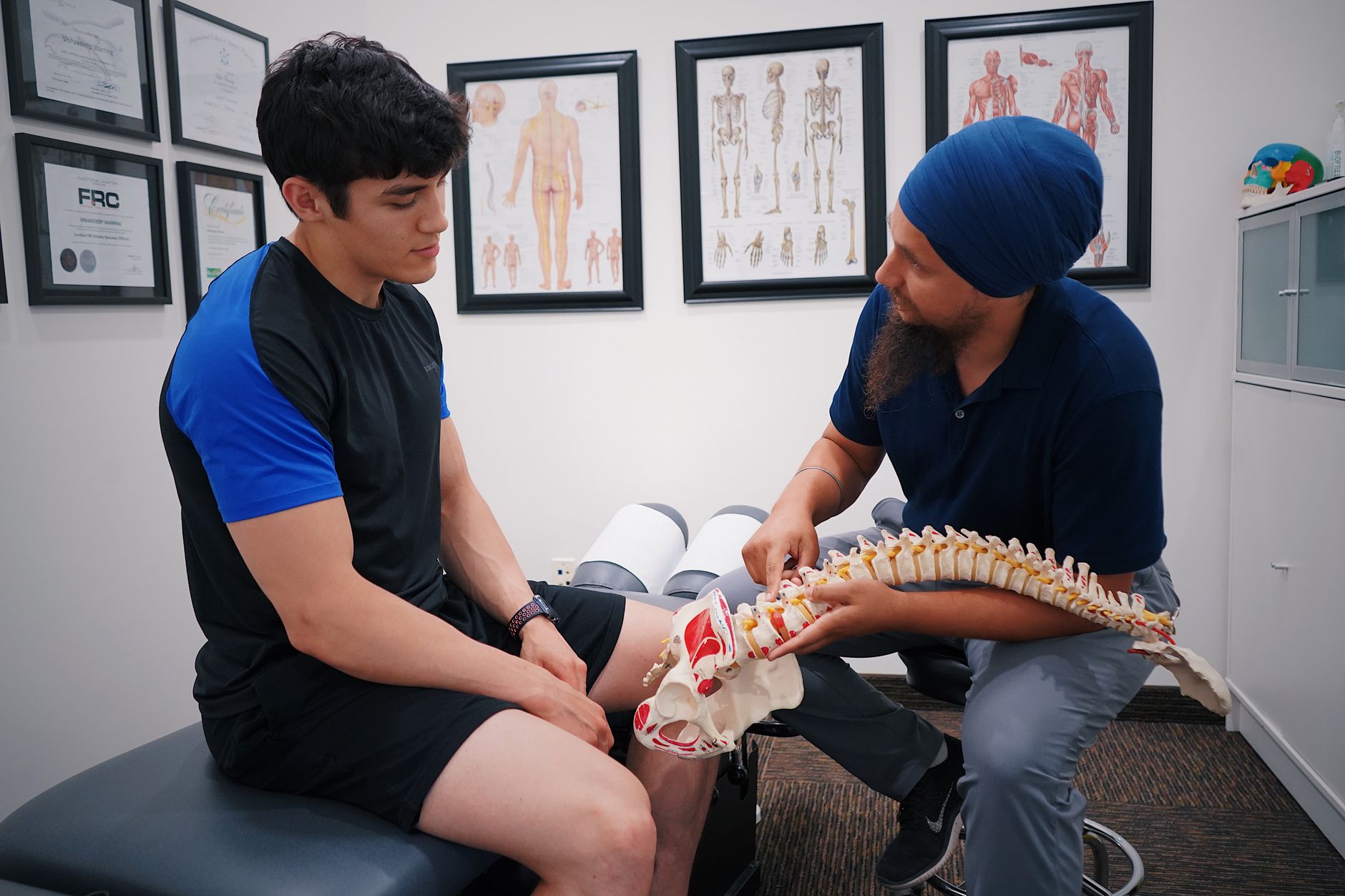
What Is a Herniated Disc? A Plain-English Guide to What's Really Happening in Your Spine
You're sitting in a doctor's office, and someone hands you a printout with the words *herniated disc* circled in red. Maybe you've been dealing with sharp lower back pain, a burning sensation down your leg, or a nagging neck ache that just won't quit. You nod along during the appointment, but the moment you walk out the door, one question takes over:
**What does that actually mean?**
At our chiropractic office serving Morrisville, PA and the greater Bucks County area, we hear this all the time. Patients come in confused, sometimes scared, and often convinced they're facing a lifetime of pain or surgery. The good news? Understanding what's really going on in your body is the first step toward real relief — and most herniated discs respond very well to conservative chiropractic care.
Let's walk through it together.
---
Your Spine Is a Stack of Moving Parts
Before we talk about what goes wrong, it helps to understand what's supposed to go right.
Your spine is made up of 33 vertebrae — the bony building blocks that stack on top of each other to form your spinal column. Between most of those vertebrae sits a **spinal disc**, a small but incredibly important structure that acts as a shock absorber, spacer, and motion facilitator all at once.
Think of a spinal disc like a jelly donut:
- The **outer layer** (called the *annulus fibrosus*) is tough and fibrous — like the dough of the donut. It's made of concentric rings of collagen fibers designed to handle compression and twisting forces.
- The **inner core** (called the *nucleus pulposus*) is soft, gel-like, and filled with water — like the jelly inside. It distributes pressure evenly when you move, bend, or lift.
When everything is working the way it should, this system allows you to move freely, absorb the impact of daily life, and protect the delicate nerves running through and around your spine.
---
So What Happens When a Disc Herniates?
A herniated disc — sometimes called a *slipped disc* or *ruptured disc* — occurs when that gel-like inner core pushes through a crack or tear in the outer fibrous layer.
Here's how it typically unfolds:
Stage 1: Disc Degeneration Over time (or after repetitive stress), the outer fibers of the disc begin to weaken. This can happen gradually due to aging, poor posture, sedentary habits, or years of improper lifting. The disc loses some of its water content and becomes less flexible.
Stage 2: Disc Bulge The weakened outer layer begins to bow outward under pressure — but it hasn't broken open yet. This is called a **bulging disc**. You may or may not feel symptoms at this stage.
Stage 3: Herniation A crack forms in the outer layer and the inner gel pushes through. Now you have a true **herniated disc**. The escaped material can press against nearby spinal nerves or the spinal cord itself.
Stage 4: Nerve Compression This is where symptoms really kick in. When disc material presses on a nerve root, you may experience:
- Sharp, shooting pain that travels down the arm or leg
- Numbness or tingling in the extremities
- Muscle weakness
- A burning or electric sensation along the nerve's path
The location of your symptoms depends entirely on *which disc* is herniated and *which nerve* is being compressed.
---
Where Do Herniations Most Commonly Happen?
Discs can herniate anywhere in the spine, but two regions bear the most load and are most vulnerable:
Lower Back (Lumbar Spine) The **L4-L5** and **L5-S1** discs (in your lower lumbar region) are the most commonly herniated discs in the body. When these herniate, they frequently compress the **sciatic nerve** — the large nerve that runs from your lower back, through your buttocks, and down each leg. This is what causes **sciatica**: that familiar shooting pain, numbness, or weakness that travels down one leg.
Neck (Cervical Spine) Cervical disc herniations — particularly at **C5-C6** and **C6-C7** — can compress nerves that travel into the arms, hands, and fingers. Patients often describe pain, numbness, or weakness that radiates from the neck into the shoulder, elbow, or hand.
Thoracic (mid-back) herniations are far less common due to the stabilizing effect of the rib cage.
---
What Actually Causes a Disc to Herniate?
This is one of the most common questions we get — and the answer is usually *a combination of factors* rather than one single event.
**Acute causes:**
- Lifting a heavy object with poor form (especially twisting while lifting)
- A sudden fall or trauma
- A car accident or whiplash injury
- A sports collision or impact
**Gradual causes:**
- Years of poor posture (think: hunching over a desk or phone)
- Sedentary lifestyle that weakens core muscles
- Repetitive bending or twisting motions
- Excess body weight placing chronic stress on the lumbar spine
- Natural disc degeneration that comes with aging
Here's something that surprises many patients: **you can herniate a disc without feeling it happen.** Sometimes people bend over to pick up something light — a piece of paper, a pencil — and feel a sudden sharp pain. The disc didn't herniate from that one small motion. It was already compromised. That final movement was just the last straw.
---
"But My MRI Shows a Herniation — Does That Mean I Need Surgery?"
Not necessarily — and this is really important.
Research has shown that **a significant percentage of people have herniated discs on MRI with zero symptoms**. A 2015 study published in *AJNR: American Journal of Neuroradiology* found that disc herniations were visible on imaging in **50% of people in their 40s** who had no back pain at all. That number climbs with age.
What this tells us is that an MRI finding is not a sentence. It's a piece of information. The real question is: **how is this affecting your function, your pain, and your daily life?**
For the vast majority of herniated disc patients — especially those without severe neurological deficits — **conservative care is the first-line recommendation**, and chiropractic is one of the most well-supported approaches.
---
How Chiropractic Care Helps a Herniated Disc
At our Morrisville office, we approach herniated disc care with a thorough evaluation first. We want to understand the full picture: where the herniation is, what's being compressed, how your movement patterns may be contributing, and what your goals are.
From there, chiropractic treatment for a herniated disc may include:
Spinal Manipulation Gentle, controlled adjustments help restore proper motion to the vertebrae surrounding the affected disc. When the joints above and below a herniated disc move better, pressure on the disc itself is often reduced. We use techniques appropriate for your specific condition — not every case calls for the same approach.
Flexion-Distraction Technique This is a gentle, hands-on technique performed on a specialized table that gently stretches and decompresses the spine. It's particularly effective for lumbar disc herniations and sciatica. The motion helps draw the herniated disc material back toward the center, reducing nerve pressure.
Soft Tissue Therapy Muscle spasm often accompanies disc herniations as the surrounding muscles tighten to protect the injured area. Releasing this tension is an important part of recovery.
Therapeutic Exercise and Rehabilitation We work with patients to build the core strength and movement patterns that take pressure off the spine and prevent re-injury. This isn't optional — it's essential for lasting results.
Postural and Ergonomic Guidance If your daily habits are contributing to disc stress, we'll help you identify and correct them. This might mean changes to your workstation, how you sleep, or how you move throughout the day.
---
What Does Recovery Actually Look Like?
This is where we want to be honest with you: **herniated disc recovery takes time.** There's no magic adjustment that resolves it overnight. But with consistent care, most patients experience meaningful improvement.
Here's a general timeline, though every case is different:
- **Weeks 1–2:** Focus on reducing acute pain and inflammation. Gentle movement is encouraged; rest is not the answer.
- **Weeks 3–6:** Gradual return of function. Nerve symptoms (tingling, numbness) often begin to improve as pressure is relieved.
- **Weeks 6–12:** Rebuilding strength and stability. Exercise and rehabilitation become more active.
- **Beyond 12 weeks:** Many patients are back to full activity. Maintenance care and good habits help prevent recurrence.
The disc itself doesn't always "go back" perfectly — but the body has a remarkable ability to adapt, reabsorb disc material, and reduce nerve irritation when given the right conditions.
---
When Should You Be Concerned?
While most herniated discs are manageable with conservative care, there are red flags that warrant immediate medical attention:
- **Loss of bladder or bowel control** — this can indicate a rare but serious condition called cauda equina syndrome and requires emergency care
- **Rapidly progressing muscle weakness** in the arms or legs
- **Numbness in the inner thighs or groin area** (saddle anesthesia)
- **Fever combined with back pain** (possible infection)
If you're experiencing any of these symptoms, please seek emergency care immediately. Otherwise, schedule an evaluation so we can assess what's going on and get you the right care.
---
You Don't Have to Figure This Out Alone
A herniated disc diagnosis can feel overwhelming. But knowledge is power — and now that you understand what's actually happening in your spine, you're in a much better position to make informed decisions about your care.
At our Morrisville, PA office, we serve patients throughout Bucks County who are dealing with back pain, neck pain, sciatica, and disc-related conditions. Our goal is always the same: help you understand what's going on, create a clear plan, and get you back to the life you want to live.
**If you're dealing with back pain, leg pain, neck pain, or any of the symptoms described in this post, we'd love to talk.** A thorough evaluation is the first step — and it starts with a conversation.
📞 [Call our Morrisville office today](https://fairlesshillschiropractor.com/) or schedule online to get started.
---
*Dr. Tony Gardner is a chiropractor serving Morrisville, PA and Bucks County. This post is for educational purposes and does not constitute medical advice. Please consult a qualified healthcare provider for diagnosis and treatment of your specific condition.*
